


ADwin-Gold-III, ADwinC, and Python
The ADwin-Gold-III real-time system, combined with the power of ADwinC programming and the flexibility of Python on the user PC, offers a robust solution for high-speed data acquisition, deterministic control, and real-time processing. While ADwinC enables precise real-time code directly on the ADwin hardware, Python serves as a user-friendly interface for configuration, visualization, and data analysis—ideal for both lab and industrial applications.
Key Features:
• Real-time processing with microsecond cycle times and nanosecond precision
• Seamless integration of ADwinC real-time code with Python scripts
• Scalable architecture for control, measurement, and automation tasks
Together, this trio creates a powerful toolkit for engineers, researchers, and developers.
Powerful Real-Time System In A Compact Format
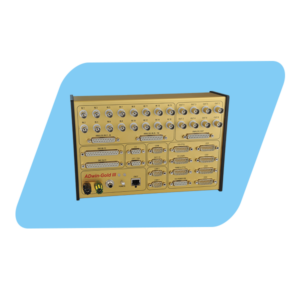
The ADwin-Gold-III is the latest real-time system from the ADwin family. It delivers high computing performance and fast system response in a robust metal enclosure – all at an attractive price point.
Equipped with a wide range of analog and digital interfaces, the system is suitable for a broad spectrum of applications. At its core is a Xilinx Zynq processor with a 1 GHz clock rate, which ensures outstanding real-time performance and processing speed. The connection to the PC is Ethernet-based. Optional expansions include counters, encoder interfaces, serial interfaces, CAN bus, and SSI, making the system highly
adaptable to specific needs.
 Typical use cases include:
• Test benches, endurance test stands, and production lines
• Special automation
• HIL – Hardware in the Loop
• EOL – End-of-Line testing
• Simulink models in real-time
• Laboratory setups and quantum physics experiment controls
• DIN-rail mounting in industrial machinery
• Mobile and in-vehicle applications
For multi-device systems, a key advantage is that multiple Gold-III units can operate in parallel, with synchronous acquisition and output across all devices – enabling precise, real-time coordination.
ADwinC – Real-Time Processes, Code Functions & Visual Studio®
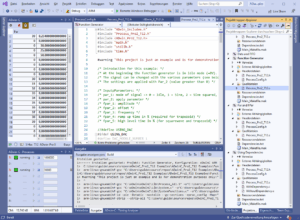
Using the C programming language, you can efficiently develop your own real-time processes while also accessing existing functions and algorithms. Functions are available for accessing data, inputs, outputs, and interfaces of the ADwin system. With a single click, the GNU compiler generates an ADwin process that runs on the real-time processor in the ADwin system with absolute precision and predictability, with cycle times from kHz up to 1 MHz.
 ADwinC for Visual Studio extends the proven development environment so that you can easily and flexibly write programs for the ADwin-Gold-III in C. In the typical ADwin program structure, you can use the advantages of the C language as usual and add access to the inputs, outputs, counters, and interfaces of the ADwin hardware. At the push of a button, the code is compiled into an ADwin process, which is then transferred to the ADwin system and started.
The ADwin process generated from C runs either in an event-triggered or cyclic mode to handle all time-critical processes with a response time of only a fraction of a microsecond. Processing and output, e.g., of a correction value after a trigger event, is so fast that response times of a few hundred nanoseconds can be guaranteed. The reliably short response time offers so much performance reserve that you can integrate complex calculations into the process.
The ADwinC software package for Visual Studio provides access to all inputs, outputs, and interfaces of the ADwin hardware. Numerous functions are available for this purpose:
• Measuring analog inputs
• Setting analog outputs
• Reading and setting digital inputs/outputs
• Starting, stopping, setting, and reading counters
• Accessing numerous buses and interfaces such as PROFINET, CAN, EtherCAT, etc
• Exchanging data between ADwin processes
• Exchanging data with the PC
ADwinC for Visual Studio supports you in debugging and monitoring running ADwin processes. Visual Studio continuously exchanges data with the running process on the ADwin system. You can display selected process data in the interface and change it online. In addition, configurable ADtools are available to you to monitor key values online, control your real-time processes, and evaluate the process timing.
The built-in timing analyzer provides reliable insight into time behavior and response time of individual processes. Debugging functions allow runtime errors to be intercepted, texts to be output, and self-defined error messages to be triggered in the running real-time process.
Python
Python consistently ranks as one of the most popular programming languages, and it has gained widespread use in the educational community, where it is widely taught as an introductory programming language. Rather than building all functionality into its core, Python was designed to be highly extensible via modules, which makes it particularly suitable for use with the ADwin system as a way to build operator interfaces, visualization tools, and other types of control and analysis applications. A library of functions allows you to directly read and set variables and arrays within programs running in the ADwin system, manage processes, and capture errors.
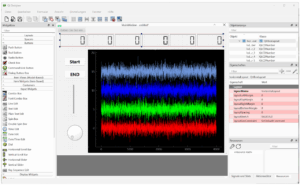
You can take advantage of Python itself, all the libraries and tools, and with the Qt Designer Standalone software, you can quickly and easily create user interfaces.
For more information on the ADwin-Gold-III, or to find the ideal solution for your application-specific needs, contact a CAS DataLogger Application Specialist at (800) 956-4437 or request more information.