


Guide to Implementing Automated Refrigerator Temperature Monitoring
Personnel installing new temperature monitoring systems in their refrigerators and freezers are often surprised to see the temperature vary up and down unexpectedly. Our temperature data loggers and fridge monitoring systems provide significantly faster response time and significantly more data than conventional thermometers which often leads to the observation of temperature behavior that was previously missed. We have put together this quick guide to help you investigate potential causes and suggest some solutions so that over time you can identify the source and control the stability of the temperature in your fridge or freezer.
There are 3 common reasons the recorded temperatures can periodically change:
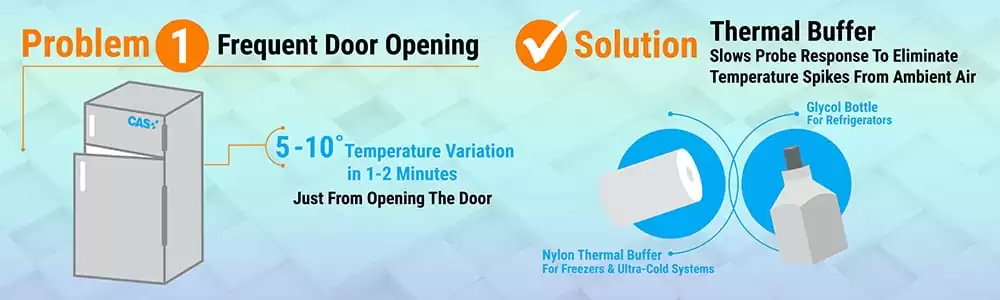
1. Frequent Door Opening
The first and simplest cause of unstable temperature readings is caused by staff opening the door, which almost immediately causes a change in the value of the refrigerator/freezer’s temperature as reported by the sensor. Please note that the actual temperature of the products stored inside is not changing this rapidly, only the air temperature as recorded by the sensor. The sensors used by electronic data loggers have much faster response times than traditional mercury thermometers and will display rapid temperature increases of as much as 5-10 degrees which might be interpreted as a problem with the system. If the presence of these jumps in temperature is an issue for your organization, you can add a thermal buffer, a small bottle of glycol or glass beads, or a nylon block, to the probe. If you take a look at the CDC Vaccine Storage and Handling Toolkit, they recommend using a buffered thermal probe. The thermal buffer provides thermal mass which will dampen the system’s response time and eliminate the temperature spikes caused by opening the door. Thermal buffers also have the benefit of making the reported temperature more closely mimic the actual temperature of the refrigerated product.
2. Refrigerator/Freezer Compressor Cycling
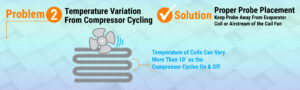
The second source of temperature variation arises from the normal cycling of the compressor used to cool the refrigerator/freezer. Again, if the temperature displayed by your thermometer is being compared to the temperature reported by your electronic monitoring system, the response time of the thermometer may be masking the actual temperature fluctuations inside the cabinet. By looking at a graph of temperature vs. time, this cycling will be revealed by a regular, periodic change in temperature. We occasionally find the probe for the monitoring system placed very close to the evaporator coil or directly in the airstream of the coil fan. These locations aren’t ideal since they experience the greatest change in temperature as the compressor turns on and off, so relocating the probe to a spot away from the coil or out of the airstream will usually help reduce variation amplitude.

Figure 1. Typical temperature cycling behavior measured at several locations inside a typical refrigerator over 2 hours.
3. Electrical Noise
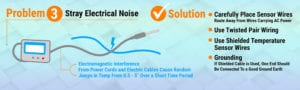
The final cause is due to electrical noise in the monitoring system. This can often be identified from the temperature data in the form of random jumps in temperature from 0.5 to 5 degrees or more happening over a very short period (such as seconds). The most common cause of electrical noise is the placement of wires running from the sensor to the actual measurement instrument. The signal levels generated with some of the common types of sensors are often in the millivolt or microvolt range. If the wires carrying these signals pass near wires carrying AC line voltage power signals for motors or other devices, it’s easy to get stray voltage induced on the temperature signal from the sensor. To fix this, make sure to carefully route wires from the temperature sensor away from any wires away from wires carrying AC power, use twisted pair wiring, and use shielded cable for the sensor wires, ensuring that the shielded cable is connected to good earth ground at just one end.
Summary
Utilizing these suggestions with your fridge monitoring system, you should be able to minimize or remove the majority of temperature fluctuations in your medical refrigerator, perishable freezer, or any fridge/freezer/cooler unit you rely on to keep your product safe.
For more information on Fridge Monitoring Systems or to find the ideal solution for your application-specific needs, contact a CAS DataLogger Application Specialist at (800) 956-4437 or request more information.