


 Fresh Cut Flower Farm Uses Automated Greenhouse Monitoring
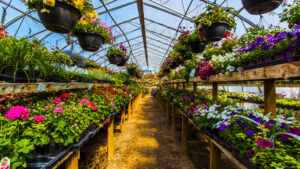
CAS DataLoggers provided an environmental monitoring solution for a large greenhouse cultivating several species of popular flowers, a highly temperature and humidity-sensitive process. The temperature and humidity requirements varied from flower to flower, with ideal temperature limits typically between 57°F and 82°F (14°C to 28°C) and a humidity of 70%–95%.
Key Factors in Greenhouse Management
Both temperature and humidity were measured at the plant canopy for the most accurate results. These factors are the largest contributors to the greenhouse’s delicate microclimate. Maintaining the correct temperature and humidity conditions throughout the growth cycle is essential for maximum growth efficiency. They are also primary indicators used to collect disease prediction data—providing the earliest warning of disease and mold outbreaks before they overwhelm entire species.
Challenges of Traditional Monitoring
Initially, the growers relied on inexpensive glass and electric thermometers for temperature measurement. However, these proved to be too time-consuming and inaccurate. Staff needed to quickly compare current measurements with previously recorded data to understand temperature fluctuations for disease prevention processes. The greenhouse was later equipped with an HVAC system to allow climate control to automatically regulate temperature and humidity. However, this system’s drawback was that climate control was limited to measurements at fixed locations.
The Need for a Comprehensive Monitoring Solution
The greenhouse owner and growers required a temperature and humidity monitoring solution that was:
- Powerful yet affordable for all greenhouse operations
- Flexible enough to allow mapping humidity distribution as well as hot and cold spots
- Effective in evaluating ventilation, heating, and irrigation
Additionally, all current conditions within the measurement cycle needed to be readily available for quick adjustments.
 Installation of T&D TR-72A2 Data Loggers
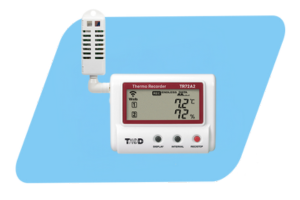
The greenhouse installed four T&D TR-72A2 temperature and humidity data loggers in key areas not covered by the existing climate control system. Each T&D data logger monitored temperatures across a range of -0°F to 130°F (0°C to +55°C) and humidity using the external sensor’s range of 0 to 95% RH. The T&D logger’s 0.5°C resolution provided highly accurate readings, which were clearly displayed on each logger’s large LCD display with multi-function viewing for real-time climate data.
Each logger’s memory stored up to 8,000 data sets with a user-set sampling frequency ranging from every second to every hour. Customized alarm settings notified growers whenever temperatures deviated from specifications. With T&D’s free WebStorage Service cloud hosting, remote access to data was simple and convenient. Personnel were able to quickly install the TR-72A2s and connect them to the greenhouse’s Wi-Fi network. The data loggers monitored the microclimate in conjunction with the climate
control system, covering the “blind spots” of its fixed sensors. Functioning like portable weather stations for detailed greenhouse monitoring, the humidity loggers
provided key information on the microclimate, such as temperature drops or changes in the diurnal range, by linking temperature data to humidity information. This combination
of historical and current data was invaluable for growers collecting comprehensive environmental information. It allowed them to reduce risks to crops by taking
measures to limit the negative effects of uncontrollable fluctuations in conditions.
This approach enabled them to achieve optimal plant growth while minimizing disease risk. As opposed to manually walking up to a thermometer to read and record
the temperature, all climate information was stored on the data logger and accessible through the web storage service via an internet browser connection from
anywhere. The logger data also aided in disease prediction for gray mold, powdery mildew, and other diseases that flourish depending on temperature and humidity
conditions. This allowed growers to determine when to apply preventative sprays or remove infected plants. Free T&D configuration software, included with each unit, was designed for ease of programming and data downloading. The user-friendly interface guided users through configuring the data logger and downloading stored data. The WebStorage Service cloud software allowed growers to combine readings from multiple loggers into a single display page.
Benefits
The greenhouse benefited in several short- and long-term ways from installing the T&D temperature and humidity data loggers. Most importantly, the TR-72A2s provided continuous, high-accuracy temperature and humidity monitoring with customizable alarm settings. The T&D temperature and humidity loggers proved to be a cost-effective greenhouse fixture. They were easily installed and retrieved by staff, enabling growers to obtain a comprehensive temperature and humidity profile of the environment and adjust conditions for maximum healthy plant growth.
Used in conjunction with the climate control system the data loggers were able to verify its accuracy and measure the areas not covered by its fixed sensor. From transplantation
to disease prevention, the entire growing process was modernized and correlated to further protect the crop. The TR-72A2’s also provided the technology to improve the growers’ documentation and understanding of the different temperature and humidity-sensitive processes at work, resulting in real cost benefits to the growers and a safeguarding a high-quality crop. Finally, as an additional precautionary option, the TR-72A2’s in concert with the Web-Storage Service free cloud storage were configured to generate e-mail notification to immediately alert the growers that temperature and humidity conditions had gone out of specification and corrections needed to be made to safeguard the crop or to adjust the microclimate for disease protection.
For further information on T&D temperature and humidity data loggers, or to find the ideal solution for your application-specific needs, contact a CAS Data Logger Applications Specialist at (800) 956-4437 or request more information.