


Your Guide to Cold Chain Temperature Monitoring
- Do perishable product losses due to equipment or power failures concern your business?
- Is your company required to comply with FDA, USDA, or other safety regulations?
- Is temperature monitoring necessary for your products or specific areas?
The cold chain system is an essential process for ensuring the safety and quality of perishable food, beverages, and medicines. Whether you’re a small business owner, transportation manager, warehouse supervisor, or purchasing agent, you stand to benefit from ensuring the integrity and transparency of your food product’s cold chain. But what exactly is the cold chain, and how can you best manage it? At CAS DataLoggers we’ve put together this introductory guide covering the basics of cold chain management using a typical temperature monitoring system so you can choose which is best for your application.
Introduction: What is the Cold Chain?
First and foremost, it’s crucial for every business to identify its major safety risks. For a food or beverage business, it only takes one missed alarm or power failure to lose your entire inventory. Managing this risk is a key priority at every link in the cold chain.
So what exactly is the cold chain? Also known as the temperature cold chain, the food supply chain, and other names, it’s the journey that temperature-sensitive products take from their point of origin through production and packaging to the final point of sale—i.e. from ‘farm to fork.’ Every ‘link’ or step of the cold chain must be monitored for temperature, from manufacturing to storage to shipping—all the way to the customer—to ensure product quality and safety.
Major Cold Chain Risks Include:
- Refrigerator/Freezer equipment failures
- Power failures
- Alarm events occurring outside of work hours (weekends, nights)
- Human error (leaving the freezer door open, etc.)
According to a study by the London-based Institution of Mechanical Engineers, up to half of the world’s food is wasted due in part to poor storage and transport methods. This is especially common when shipping food to vendors. That’s why an effective cold chain needs to extend beyond just your plant or warehouse, going all the way to the receiver.
Which Regulations Impact Your Business?
As every food manufacturer and shipper knows, regulatory compliance is vital to stay operating and to ensure product quality. According to the US FDA “The FDA Food Safety Modernization Act (FSMA), the most sweeping reform of our food safety laws in more than 70 years, was signed into law by President Obama on January 4, 2011. It aims to ensure the U.S. food supply is safe by shifting the focus from responding to contamination to preventing it.” Among other regulatory pressures, FSMA mandates that Food & Beverage manufacturers monitor and document their products’ entire temperature history.
Another widespread regulation, Hazard Analysis and Critical Control Points (HACCP) is a general, industry-adopted form of best practices that many businesses closely adhere to. As with FSMA above, the emphasis is on hazard prevention through measurement and documentation rather than just product recalls. HACCP is effective because it applies to each link in the cold chain. Before sourcing a cold chain solution, be sure to first identify the specific regulations your business is subject to, be it for meat and poultry, milk and dairy, pet food, etc. Once you know your exact requirements, you can determine which temperature data logger is right for your application.
What is a Temperature Data Logger?
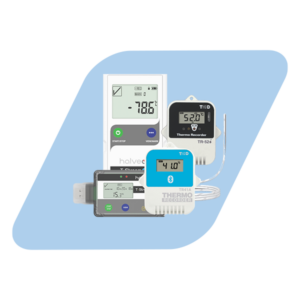
What is a temperature data logger? Data loggers are stand-alone electronic devices— often palm-sized or smaller and inexpensive– typically battery-powered and designed to collect and store temperature or other measurement values, independent of a PC.
Data loggers are much more reliable and accurate than manual measurements, and their automated operation frees up employees for other work. Ideal for use in the cold chain, temperature logger can have internal sensors or connect to external sensors and record readings to their internal memory or an external storage device, such as an SD card. They also feature automated alarm capabilities to provide an immediate indication of a problem making them an all-in-one system.
Many Cold Chain Temperature Data Loggers are designed for a specific use, such as for monitoring refrigerators and freezers, food preparation areas, and more. Increasingly businesses are using these specialized devices to safeguard their products and satisfy regulatory demands. Whether you need a simple single-channel unit to log temperature in a case of food or a multi-channel system to monitor the temperature in a large refrigerated warehouse along with other parameters at the same time, you can find a data logger to meet your exact needs.
Why Use Data Loggers?
Proof of Best Practices to Regulators: You need an easy way to document the entire temperature history of your product without having workers spend time taking manual temperature measurements. Replacing outdated, manual temperature data collection with automated data logging provides more accurate data that is automatically archived with no human intervention required. This electronic documentation also helps ensure that you have a quick way to give proof to regulators that your product or environment was kept in temperature spec for the entire storage or trip duration.
Alarm Notification: Data loggers also serve as a reliable, dependable alarm system. Simple models can be programmed with the appropriate thresholds and provide immediate indication via an LED if the limit has been exceeded. More sophisticated models incorporate network connectivity such as Ethernet, WiFi, cellular, or LoRaWAN and can send notifications via email, push notification, or even voice message phone calls. This is especially useful on weekends so that you don’t return on Monday morning to find that your freezer failed overnight!
Improved Product Quality: Just as coffee brewers use temperature sensors to experiment with different roasting temperatures, similarly you can improve and fine-tune your own product quality by using temperature data loggers. Taking a look at this temperature history gives you the hard data you need to see actual conditions at every step of your cold chain, from field to manufacturing to storage to shipping.
 Where Should You Monitor Temperature?
- Refrigerators and Freezers
- Walk-in Coolers and Deli Freezers
- Warehouses
- Refrigerated Compartments in Trucks
What Kind of Data Logger Should You Consider?
Whether you’re a purchasing agent or a small business owner who’ll be using the logger, you can help find the right device by first deciding what features you need. Typically data loggers use internal or external temperature sensors to record temperature data. While some of these loggers are dedicated to a certain input or sensor type (such as thermocouples), others are programmable and scalable for different sensor types. The sensor type is determined by several factors including the range of temperature measurements, the required accuracy, and any physical requirements such as does it need to be immersed in a liquid or inserted into the product being measured.
Many data loggers are more than accurate enough to suit cold chain applications, but some situations benefit from higher-accuracy models capable of measurement to within one-tenth of a degree. Most devices for industry and individual use are battery-operated, while some intended for a more permanent installation, for example in a warehouse, can be powered externally. Thinking beforehand about these details will help you decide what kind of logger you need and will also give you a baseline when you speak to an experienced cold chain solutions provider.
Should You Go Wired or Wireless?
Communication with the data logger can be handled in many different ways, including USB or Ethernet interface, wireless capability including Wi-Fi and proprietary radio links, Bluetooth, cellular modem, and more.
Often your selection will already be made for you depending on your particular facility’s wired or wireless setup.
4 Common Types of Temperature Monitoring Systems:
Standalone Transit Data Loggers operate independently of computer. They collect the measurements and store them in internal memory. Typically these devices are for a single temperature or temperature/humidity measurement. They either use USB or Bluetooth for data retrieval. Some models feature the ability to automatically create a PDF report file when connected, eliminating the need for special software to retrieve the data. There is also a choice between low-cost single-use loggers which are good for a limited duration and then can be thrown away or recycled or more durable multi-use models that will continue to reliably operate for at least a year. Standalone devices are widely used in the transportation industry to track shipping conditions inside a truck, rail car, or cargo plane. They are the ideal choice when:
- The manufacturer, shipper, and end customer are all different organizations and the device is going on a one-way trip.
- Cost is a major concern.
- The data is primarily for verification and alarming is a secondary.
Wired Data Loggers utilize a central data logger with a wired connection to sensors placed in different locations. With a wired device, you don’t have to worry about wireless range, which can unexpectedly complicate matters if you haven’t considered it beforehand. These systems can be used in production facilities or warehouses where the initial cost of installing cabling can be amortized over a long period of time. Having all the measurements brought back to one point simplifies data management and allows for centralized alarming. In addition, the logger can be connected to the LAN to provide the features of the networked data loggers (below).
Wired systems are the ideal choice when:
- Your facility has too many obstructions (or otherwise limits wireless range)
- You have an existing wired network that you plan to use
- You’re able to run cabling and have specific concerns about wireless devices and data integrity.
Wireless Data Loggers have two parts, one or more measurement devices that collect and transmit the data and a wireless base station or gateway that receives the data, processes it, and then uploads it to a PC, server, or cloud-based site. By using proprietary wireless protocols they can offer a range of 500 feet or more between the transmitters and the base station making them suitable for large warehouses. These devices can provide data and alarms in near real-time giving personnel time to save food products.
Wireless systems are the ideal choice when:
- You have several distributed points where you need to measure the temperature
- It would be difficult or expensive to run wires from your measurement points back to a central location
- Data needs to be collected and transmitted from a truck or other vehicle while it’s in motion, preventing the use of wired sensors
Data and/or alarms need to be collected from a site that’s difficult to access or does not offer regular internet connectivity. Some layouts make wireless system deployment difficult. As a quick exercise, look around the area you need to monitor. Consider whether the units would have a clear line of sight to a gateway or a repeater, or if their communication would be obstructed by walls, floors, or objects.
Networked data loggers use a LAN or Wi-Fi connection to automatically transmit their data over your facility’s network to an office PC, server, or to a cloud-based service. They can provide near-instantaneous alarms via email, SMS, or even a voice call. Network-connected devices are quickly becoming universal in the food and beverage industry as a way to help businesses and organizations pass inspections and ensure product quality. They are ideal for applications where the cost of lost product or risk is very high. Networked loggers include individual 1 or 2-channel data loggers with a LAN connection that can be distributed around a facility.
How Do You Want to Receive Alarms?
Alarms are a standard feature of temperature data loggers that provide immediate notification of temperature excursions in your product or environment. Specifically, these devices alert you through a variety of methods whenever their configurable temperature limits are exceeded.
Alarm delivery methods include:
- Audible Alarms— If you know that personnel will be in the vicinity or if you’re in no danger of losing product, an audible alarm might be enough for your purposes. Just be sure that there are no consequences for missing an alarm! A good rule of thumb is to assume that someone won’t be in the room every time the alarm goes off.
- Visual Indicator— First ensure that the temperature logger is located somewhere with high traffic so personnel have a fast response time. These are useful for transit applications where the receiving party can immediately determine if the product remained within the required temperature range during shipment by looking at the indicator on the logger.
- Emails— Email alerts are equally convenient. For critical applications, you’ll want to ensure that you’re aware of when you’re emailed. Many users use their mobile devices to give them an audible notification when they have an incoming alarm email.
- SMS Text Message— SMS text alerts are a popular way to get an instant heads-up on alarm events. Once configured, the data logger automatically sends alarms out to specified personnel.
- Phone Calls— Some systems provide dial-out capability to a landline or cell phone, enabling immediate notification virtually anywhere. An example of these monitoring products is the Accsense Monitoring family of wireless temperature, humidity, and environmental monitoring systems.
Temperature Monitoring Kits:
If you want to simplify your search, we have a number of Refrigerator and Freezer Monitoring Systems for the cold chain monitoring of temperatures in refrigerators and freezers. These kits provide a simple and effective solution that is easy to install and provides temperature alarm functionality. Based on wired Ethernet, Wi-Fi, or wireless hardware, we have the solution to your temperature monitoring problem.
Each kit is made up of temperature sensors and a data logger or network-connected device to record and transmit data to either a cloud-based server or to a location on your internal network. The sensor is placed inside the refrigerator or freezer cavity with the electronics located outside. Data and current temperatures are available from the included software or by using a web browser to the cloud server. Many of these solutions require little to no IT department involvement.
How Often Do You Need to Collect Data?
After determining what temperature range you need to log in and where you need to log it, it helps to decide how often you need the data logger to take a reading. In most temperature monitoring applications, users only need to take a temperature sample once every 15 or 30 minutes just to keep tabs on a specific product or environment. Depending on your temperature recording application, you may need to only capture a few hours or days’ worth of data or you may need the logger to store months’ worth of readings.
Concerning the specific data logger, there may be a limit based on the total amount of internal memory, or the logger may offer the option of using external memory such as a USB memory stick. Be sure to check the logger’s spec sheet for its battery life. Nowadays, many data loggers ensure that recorded data is kept in non-volatile memory so it will remain safe if the battery fails or power is lost.
What Software Features Do You Need?
Data logger software is used to control the operation of the system. Software features include:
- Configuration/Setup—This is an area where a user-friendly interface really pays off. You want to be able to quickly move through naming sensors and setting temperature limits, and sample rates. Wireless data loggers now offer remote configuration and setup.
- Data retrieval—You’ll want to be able to retrieve your data as quickly and easily as possible—as above, intuitive software really helps here.
- Alarm management—Here you’ll choose who will receive alarms and how they’ll be notified, whether over email, text message, or even landline phone calls with some models.
- Charting—Useful for identifying and displaying data trends such as temperature profiles or temperature spikes. Depending on your product, this feature may help you to increase product quality as well.
- Report Generation—The ability to easily generate compliance reports may be necessary for proof of your best practices to the FDA or other regulatory bodies. Some devices offer the ability to directly export PDF reports which greatly simplifies documentation and record keeping.
Conclusion:
Effective cold chain management is crucial for ensuring the safety, quality, and integrity of perishable products. By implementing a robust temperature monitoring system, businesses can mitigate risks, comply with regulatory standards, and ultimately enhance their bottom line. Data loggers provide valuable insights into the temperature history of products, enabling proactive measures to prevent spoilage and product recalls. As technology continues to advance, cold chain solutions are becoming increasingly sophisticated, offering greater accuracy, reliability, and convenience. By investing in a comprehensive cold chain management strategy, businesses can safeguard their reputation and deliver high-quality products to their customers.
For more info on data loggers, or cold chain temperature monitoring, or to find the ideal solution for your application-specific needs, contact a CAS Data Logger Applications Specialist at (800) 956-4437 or request more information.