


Temperature measurements are among the most common data logging applications found across a broad variety of industries including cold chain integrity, medical monitoring, machine/equipment monitoring, environmental monitoring, and in practically every other field. Since temperature monitoring devices are designed for such a wide variety of needs, it’s important that you decide on the type of sensors to use.
One type of sensor that is seeing expanded use in a number of applications are solid-state temperature sensors. These devices are from the same family as transistors, integrated circuits and LED’s. Solid state sensors are ideal for many temperature monitoring applications, such as cold chain data loggers, temperature measurement in life sciences and environmental monitoring. In our latest White Paper, CAS DataLoggers covers the basics of solid-state temperature sensors and how they might benefit your application.
What are Solid-State Sensors?
 Like other types of sensors such as thermocouples and RTDs, solid-state temperature sensors measure a physical value and then convert it into an electrical signal that can be measured. The sensor (as part of a probe) captures its temperature by means of a diode, transistor or voltage reference that has a well-established voltage vs temperature characteristic. They typically include signal-conditioning electronics to generate a scaled voltage or current output that is proportional to temperature. For example, the Analog Devices TMP35 transducer provides a linear output voltage of 10mV/°C with an output of 250 mV at -25°C.
These devices only require a simple voltage or current measurement and linear calculation to convert the output signal to temperature.
Taking their name from the family of semiconductor electronic devices, solid-state sensors have no moving components (unlike transducers, switches etc.) and incorporate additional circuitry to provide an easy to use output. As a good alternative to thermocouples, solid-state temperature sensors are also an effective way to capture the temperature data of a specific product or to continually monitor an industrial process (for alarm purposes, etc.). As an additional benefit, newer devices come pre-calibrated with traceable data. This means that:
- There is no need for an additional initial calibration step.
- If there are multiple sensors in a system, they can be interchanged without a loss of calibration
- If the sensor ever fails, it can simply be replaced with a new one and the calibration of the temperature measurement system is maintained.
Why Use Solid-State Temperature Sensors?
By relying on the same technology as other mass produced electronic devices we rely on every day such as computers, cell phones and TV’s, solid-state temperature sensors are very inexpensive especially given their high degree of accuracy. Consider using semiconductor sensors when price is a factor and you have a very specific temperature range in mind. Three of the most common types of these sensors are the AD590 series from Analog Device which provides a current output of 1 uA/ °K, the LM 35 series from Texas Instruments which provides a 10 mV/°C output and the TMP36 from Analog Device which also provides a 10 mV/°C output. In addition to these, there are several other types such as silicon diode sensor for ultra-low temperature measurements.
Solid-state sensors are also ideal for less tech-savvy users, being straightforward in operation. They’re easy to connect to a datalogger, noise-resistant, and don’t require additional signal conditioning in the form of expensive add-on devices. This sensor type is also easy to use with most types of digital measurement systems like meters or single board computers.
Naturally there are a few considerations to keep in mind when using these devices (i.e. potential drawbacks). Like thermistors, solid-state sensors lack the wide temperature measurement range of many thermocouples, so you may need to use the latter if your need to measure very low or very high temperatures. Additionally, other types of temperature sensors like thermocouples or RTD’s are more common, there are more styles available which may be better suited to the mounting requirements for your particular application.
| Thermocouple | RTD | Thermistor | Solid-State Sensor | |
| Accuracy | 1-2 °F | Better than 0.5°F | Better than 0.5°F | 1-2°F |
| Measurement Range | -290 – 4200 F | -328 to 900F | -100 to 450F | -67 to 220F |
| Ease of measurement | Requires uVolt measurement + cold junction reference | Requires very accurate measurement resistance | Can require high resistance measurement | Uses simple voltage or current measurement |
| Calculation of temperature | Requires complex equation or look-up table to convert voltage to temperature | Requires polynomial equation to convert resistance to temperature | Requires polynomial calculation to convert resistance to temperature | Simple linear equation to convert voltage to temperature |
| Calibration | Calibrate against known temperature standard | Calibrate against known temperature standard | Calibrate against known temperature or resistance standard | Can be pre-calibrated at time of manufacture |
| Variety of probe styles | Largest variety of probe styles | Many different styles | Many different styles | Limited probe styles |
| Cost | Moderate | Moderate to high | Low | Very low
|
Table 1. Comparison of various temperature sensors
How Do You Measure These Sensors?
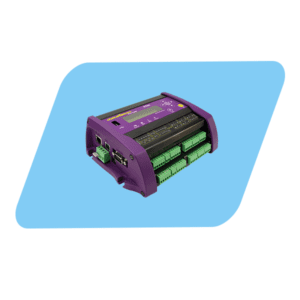 Dataloggers are available in many different styles which are able to measure and record electrical data from external temperature sensors including thermocouples, RTD’s and semiconductor sensors. When selecting a data logger for use with solid-state sensors, make sure to select one that is designed to accept the type of output signal from the temperature probes and your specific sensor type. Most devices will incorporate software to allow you to scale the raw signal to temperature as it is being recorded. Also, be aware that most of these sensor will require some sort of external power such as 3.0 to 5.0 VDC either from the data logger, power supply or battery. From some applications for just one or 2 measurements, a simple voltage datalogger like the TandD MCR-4V may be all you need. Consider a universal input data logger like the dataTaker DT80 If you want a multi-channel system to log several temperature inputs and other parameters at the same time.
Conclusion
Solid-state temperature sensors offer an attractive solution for a wide range of temperature monitoring applications. Their affordability, ease of use, and compatibility with various data logging systems make them a practical choice many projects. While they may not possess the wide temperature measurement range of thermocouples, their accuracy, reliability, and straightforward operation make them ideal for many common applications.
By understanding the benefits and limitations of solid-state temperature sensors, users can make informed decisions to optimize their temperature monitoring strategies and achieve accurate and reliable results. If you’re seeking a cost-effective and user-friendly temperature sensing solution, solid-state temperature sensors are certainly worth considering.
The Data Logging Experts:
As one of the largest datalogger distributors in North America, CAS DataLoggers has sold automated monitoring solutions and real-time systems to customers since 2001 and has been in business for over 20 years. Customers can select from hundreds of different models from over 16 trusted manufacturers to tackle all manner of data recording applications.
Users can select from many models of temperature dataloggers which can read the signals from thermocouple sensors including wired and wireless models, lightweight and compact units, power over Ethernet loggers, etc.
For further information on Temperature Data Loggers, water flow monitoring solutions, or to find the ideal solution for your application-specific needs, contact a CAS Data Logger Application Specialist at (800) 956-4437 or request more information.