


L.A. County Museum of Art Conservation Project
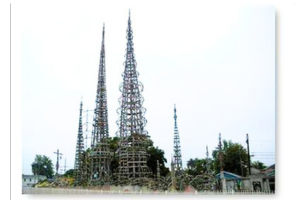 CAS DataLoggers played a pivotal role in providing the structural monitoring solution for the Los Angeles County Museum of Art (LACMA) as it embarked on its conservation project for the Watts Towers, a renowned monument of regional folk art. Constructed by Italian immigrant Simon Rodia between 1921 and 1954, the Towers stand as an iconic testament to Los Angeles’ cultural heritage. The tallest structure reaches nearly 100 feet, with 17 towers crafted by hand using steel rods, wire mesh, and cement, adorned with mosaics made of ceramics, shells, bottles, and tiles. These unique pieces reflect the contributions of Rodia’s community, who helped him gather materials over the years. Named a National Historic Landmark in 1990, the Watts Towers, also called ‘Nuestro Pueblo,’ have become an enduring symbol of artistic ingenuity, standing proudly in the city even after Rodia’s departure in 1955.
Developing A New Preservation Plan
In October 2010, LACMA contracted with the city’s Dept. of Cultural Affairs to preserve the towers by conducting daily maintenance on the site and by revising the 1983 Conservation Handbook to develop a new preservation plan. Over the past 40 years, workers have attempted to patch the towers’ cracks, but the damage kept reappearing. To effectively restore the Watts Towers, LACMA’s Conservation Dept. needed to see how these structures were behaving under several environmental influences.
Dr. Charlotte Eng works as part of LACMA’s Conservation Center and has helped to restore much of the Museum’s collection over several years. As a Conservation Scientist and a Doctor of Materials Sciences and Engineering, Dr. Eng specializes in identifying needed materials and repairs to many different types of artwork. She and the rest of the team have worked to restore and protect one of LA’s most impressive and accessible art installations.
Analysis to Develop Restoration Efforts
The LACMA team’s efforts focused on finding and monitoring the movement of cracks in the site’s cement covering and fissures. To do this, the Department needed to capture movement or displacement data to see where the fissures were opening and to what extent. The conservation team then repaired the cracks using a custom repair material consisting of elastomeric crack fillers and polymer-amended mortars. This will ensure that the repaired areas move by the rest of the structure to preserve its overall integrity.
LACMA also worked with UCLA’s Department of Engineering to record a combination of structural response and environmental data that will show where the damage to the structure is originating, which will guide all future efforts. Macroscopic monitoring techniques have already been undertaken on the site and structure, including telephoto photography, radiography, and the use of high-magnification spotting scopes. Dr. Eng explains, “The Towers have also been laser-scanned and analyzed with ground-penetrating radar sweeps to show us the ground’s stability.”
Additionally, the Watts Towers are affected by many other factors including the day’s heat, wind speed, seismic activity, and more. For example, tilt meters have confirmed that the top of the main tower moves slightly as the day progresses and begins moving back again in the evening. This produces slight movements causing stresses that crack the concrete and cause other deterioration such as loss of the Towers’ ornamentation. To combat this, the team has to continually monitor the movement of the Towers and their foundations.
LACMA’s project supervisor and Senior Conservation Scientist Dr. Frank Preusser has over 40 years of experience working with prestigious sites including the Egyptian pyramids, the Getty Museum, and museum-based work around the world. He and the department searched for new damage and areas where the Towers were losing their ornamentation. This work required a high-accuracy data logger that could connect with the project’s specific type of displacement sensors. With this in mind, Dr. Eng contacted CAS DataLoggers to find a portable device that allows users a quick way to get the data: “As a guide, we looked at monitoring projects conducted by other institutions such as UCLA which have successfully used a similar setup.”
System Installation:
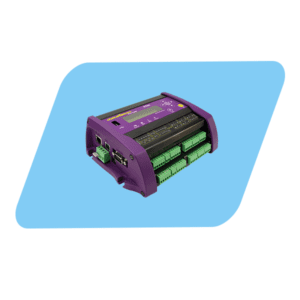 LACMA’s Conservation Department has implemented a dataTaker DT80 Intelligent Universal Input Data Logger, provided by CAS DataLoggers, to assess the structural condition of the Watts Towers during its ongoing conservation efforts. This advanced system continuously monitors the towers, with the team strategically placing the portable data logger around the base of the central tower to take critical readings. As the inspection uncovers cracks, particularly around the base where the majority of the structure’s weight is concentrated, the DT80 will be relocated and mounted to a support structure above ground level. Notably, cracks are less common near the top of the towers, where the concrete and rebar are thinner and more flexible. Designed for durability, the DT80’s removable screw terminals ensure a secure installation in this outdoor environment, while its plastic cover safeguards the device from rain. Thanks to its rugged construction, the dataTaker DT80 can be left outdoors without concern, making it an ideal tool for monitoring the towers despite any unpredictable changes in LA’s weather.
The team is currently using a pair of Firstmark Series 150 Subminiature Position Transducers to monitor the movement of the cracks, relocating the sensors around the base of the central tower’s structure to find which cracks are moving through trial and error. The DT80’s built-in excitation sources are used to power the sensors. These transducers use a measuring cable affixed to an attached shaft and spring loaded spool that is attached to a rotary potentiometer. With the sensor attached on one side of the crack and the end of the cable on the other side, as the crack opens or closes the movement of the string causes the potentiometer to rotate changing the resistance measured by the data logger.
This way, the sensor translates a crack’s linear movement into a variable resistance which the dataTaker reads and records. Once a new crack is found, each sensor’s cable measures its linear position to see how much and how quickly it’s opening and closing. Users set up the dataTaker to take a reading from each sensor once every 15 minutes as suggested by CAS DataLoggers. With the ability to measure up to 15 analog inputs, an 18-bit measurement resolution, and digital, counter, and serial sensor inputs, the dataTaker data loggers can read data from most sensors allowing the team to add sensors to capture other data like temperature, humidity, wind speed and wind direction. Add on CEM20 channel expansion modules allows the DT80 to measure up to 100 analog input channels. An internal lead acid battery allows the logger to run for an extended period of time without external power. In this case, with a 15-minute sampling interval, the logger could run for over a month on battery power allowing the team to easily collect survey data without the need for an external power source.
Data Collection:
The DT80 data logger stores up to 10 million data points in its user-defined memory so that users can log as much or as little as needed, with the ability to independently control schedule size and mode. The logger’s flexible COM drive from the datalogger’s USB port quickly collects the data. Once a month, a team member climbs up a short ladder to pull out the Flash drive, puts it in a laptop to download the data, and replaces it.
Dr. Eng explains, “We’ve retrieved the data and now we’re checking it for evidence of any seismic disturbances since earthquakes are frequent in this area. Other influences may result in extreme data, such as the ‘Santa Anas,’ the hot winds blowing in from the desert at 50 to 60 miles per hour, so we’re looking for those indications too.”
Analysis Software:
In addition, dataTaker’s dEX2 graphical interface software is provided with the data logger. This user-friendly, Windows Explorer-style software enables quick setup and configuration, suitable for both novice and advanced users. The software runs on a standard Windows PC and communicates with the logger via a USB or Ethernet connection. The dEX2 software provides a simple dashboard with displays of real-time measured values plus trend charts that could show the movement of the cracks over days or weeks.
Benefits:
The dataTaker and string potentiometers are well within the Conservation Department’s budget, the real advantage being that the measurements and software are packaged in a single system. Dr. Eng sums up why LACMA chose dataTaker for their application: “We had several needs for this phase of the project: our system had to be portable, it had to be small, and it had to last more than a week or two. This system runs on its own out there indefinitely, it’s easy for us to get the data, and its compact size and removable screw terminal connections make it easy to install and connect the sensors.”
She continued, “We looked at similar projects using data loggers, but they had large and heavy batteries or they had to be hardwired first. We knew we wanted something standalone that would save us all that work; the USB retrieval is very handy and can be done by anyone at any time. Someone just brings a laptop and collects the data that way.” From there, the data can be analyzed in detail from an office PC.
The team can easily put the versatile dataTaker to work on other projects, using its universal inputs to log other values. “We can also use it for our strain gauge sensors. The logger we currently use to take strain gauge data is much bigger, about 12 x 12 inches and 3 inches thick, so it will be much easier to just use the dataTaker for that application too.”
As conservator of the Watts Towers, LACMA’s ongoing restoration work with this new data collection technique is helping to revolutionize how art installations are restored and preserved. Thanks to the Conservation Department’s efforts, the near century-old Watts Towers will continue to amaze visitors to Los Angeles for decades to come.
Learn more about UCLA’s equipment site which is part of the Network for Earthquake Engineering Simulation (NEES) at http://www.cee.ucla.edu/.
For more info on the dataTaker DT80 Intelligent Data Logger, or to find the ideal solution for your application-specific needs, contact a CAS DataLoggers Application Specialist at (800) 956-4437 or request more information.