


Grant Data Logger for Animal Skin Temperature Measurement
 Zoos, shelters, universities, and other organizations often need wildlife monitoring equipment to measure and record temperatures from animals for conservation and research. These applications include both short-term and ongoing projects in species conservation, animal husbandry, and incubation. In many of these projects, staff also need alarming capability for key events like new arrivals, sick animals, infant births, and other emergencies. At CAS DataLoggers we regularly receive calls from customers working on these applications and help them to find the right data logger for their projects.
Here are four common examples of data collection methods that our experienced Applications Specialists have helped provide for our customers:
Monitoring External and Internal Temperature
A common application involves continually monitoring animals by recording their skin or internal temperature data. Surface or rectal temperature probes (usually thermistors) connected to portable data loggers are an effective means for measuring and viewing all the minute temperature changes occurring over both short and long periods. After looking at the data, staff can then take preventative measures to help prevent a fever, serious infection, or disease. For easy accessibility, all these temperature readings should be displayed on a compact device with user-set alarm thresholds. When deciding on a model for a temperature recorder, a handheld device is a big asset in limited-space enclosures and observation areas. As an example, the portable Grant SQ16 Portable Universal Input Data Logger can connect to thermocouple or thermistor probes for extreme accuracy along with fast response times. The SQ data loggers feature 8 to 16 universal analog inputs to monitor and record all the data they collect from highly accurate skin or rectal temperature probes. The data logger’s LCD shows the animal’s current skin temperature to be monitored in real-time using a mobile app connected via Bluetooth and at the same time record it on the logger’s internal memory for future analysis.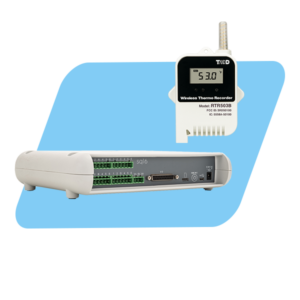
Additionally, the Grant logger’s 2 alarm outputs can connect to an external alarm device (such as a light or siren) when temperatures go outside the ranges you’ve set. For extended recording, these universal loggers can store up to 200 million readings in their onboard memory. The SQ16 comes with SquirrelView to configure the device and view/organize stored data. SquirrelView provides a user-friendly interface along with analysis and customized reporting capabilities. Data transfer to SquirrelView is accomplished via the logger’s USB interface.
Monitoring Temperature & Humidity Conditions Inside Burrows, Dens, and Other Living Spaces
Instead of monitoring animal temperatures directly which can be time-intensive, you can instead opt to record the temperatures of their burrows, dens, and other habitats. As an example, we provided an environmental monitoring solution to the owner of a turtle sanctuary in Ojai, California. The shelter adopts Sulcata tortoises and currently has 4 active burrows, spaced about 50 ft. apart. Any temperatures below 50°F are cause for alarm, and conditions over 95°F also pose health risks to the animals. The temperature and humidity data had to be captured from 4 ft. underground, necessitating a wireless solution due to the difficulty of getting a good signal. Before contacting us, the owner would extend a tape measure with an attached sensor down a burrow and wait until it had taken a reading 20 minutes later. “That just took too much time. I knew there had to be a better way.” He needed a wireless monitoring and alarming system that could remotely gather environmental data and send email alarm messages to his mobile device whenever conditions went outside safe ranges.
For this application, CAS provided the sanctuary with 2 T&D RTR-503B Wireless Temperature and Humidity Data Loggers and a T&D RTR-500BW Wireless Base Station. The RTR-503B comes with probes that have a 1-meter-long cable to connect to the data loggers, allowing them to be installed into the ceiling of each burrow. Using a vertical conduit, the owner placed a 1-inch diameter PVC pipe underground, connected to the wireless data loggers placed aboveground in small plastic boxes glued to the conduit. The data loggers each monitor a different burrow, and when the owner wants to move them around, their compact design allows easy repositioning.
 The loggers record a sample once an hour and transmit the high-accuracy readings from the sensors in the caves out to the remote base station. The wireless base station inside a nearby farm window communicates with the data logger in the closest burrow in a direct line with the barn about 100 ft away. The wireless base station inside a nearby farm window communicates with the data logger in the closest burrow in a direct line with the barn about 100 ft. away. This data logger is about 150 ft. away from its twin in another burrow, well within each logger’s 500 ft. outdoor communication range. T&D’s durable construction ensures that the data loggers survive long-term exposure underground.
Meanwhile, the alarm levels continually monitor all this data for any temperature or humidity reading outside the user-set safety limits. In the event of any value going out of specification, these alarms send warning emails directly to the owner’s cell phone so he can contact volunteers and take immediate preventative measures.
This wireless monitoring and alarming solution now saves the shelter a lot of work and worry. The owner explained: “I think the equipment’s just what I need. I want to share this with people who have Sulcatas so they know if their environment is safe for the animals, and that’ll work no matter where you’re keeping them.”
Monitoring Bat Migration
In another wildlife monitoring equipment setup, CAS DataLoggers provided several data logging systems to monitor bats in a sitting area for wind turbines. The customer had specialized instruments that were able to monitor the bat population by capturing and classifying the echolocation calls of the bats. This device had a Modbus serial interface that allowed the data to be offloaded. Using a dataTaker DT82I datalogger equipped with a cell modem, they were able to automatically download the data from the bat monitor and then upload it via the cellular connection to their server eliminating the need to visit the remote site to retrieve data. The entire system was powered using a solar panel and battery provided as part of the package by CAS.
Monitoring Water Temperature in Enclosures & Habitats
Another common application for environmental data loggers is to measure the temperature in an enclosure or habitat, or even to record local weather conditions. For this type of project, CAS Dataloggers offers you a selection of specialized data loggers supporting a wide range of sensors used in environmental monitoring to capture and record current conditions.
From simple 1 and 2-channel data loggers monitoring temperature and humidity to intelligent multi-channel instruments that can be used with weather stations and other sensors to provide real-time information and capture historical data, we can help you choose a system that meets your exact requirements. Be sure to select a datalogger that’s durable, weather-resistant, and/or available in a weatherproof enclosure to handle exposure to the elements. Whichever of these applications suits your needs, CAS DataLoggers can provide your project with effective monitoring and alarming technology for any budget. We’ve provided monitoring solutions for every industry and setup. Give us a call to learn more!
For more information on our Grant Data Loggers, T&D Data Logging Systems, and wildlife monitoring equipment or to find the ideal solution for your application-specific needs, contact a CAS DataLogger Application Specialist at (800) 956-4437 or request more information.